














The World Street Fishing Event 2019 is part of the World Predator Classic. Until now, both tournaments had been held simultaneously in Hellevoetsluis in the Netherlands. This year, the Street Fishing Event was held for the first time as a standalone competition in Metz, France — a change that significantly streamlined the organisation and flow of the whole event.
Street fishing means travelling light through the urban waters of Europe, targeting the typical predators you find there. The trend has grown enormously in recent years, and most major manufacturers have already launched dedicated product lines for this popular style of lure fishing.
The Key Rules of #WSF2019
The event ran from 31 May 2019 to 2 June 2019 in Metz, France. The Moselle flows through the city both as the main river and through a network of smaller canals. Friday was largely given over to registration, getting to know fellow competitors and, yes, celebrating with them. Fishing took place on Saturday from 14:00 to 22:00 and on Sunday from 08:00 to 15:00.
The WSF19 is a strict catch and release event, which also means that bleeding or dead fish are not counted. As a result, every competitor handled the fish with exceptional care.
Up to five fish per day could be entered into the scoring, covering perch, pike, zander, chub and asp. The ever-present wels catfish were excluded from the count. At the end, the total centimetres of fish caught across both days were added up to determine the winner.
Mandatory kit included a landing net, a sheet-pile landing net, an unhooking mat and unhooking pliers. Competitors were allowed to carry two rods, and only lures were permitted.
Every catch had to be photographed twice: first on the scale that was issued to each angler, then in the hands of the person who caught it. Both competitor cards had to be visible for identification, and the fish always had to face the camera with its left flank showing. Simple enough in theory, but in the heat of the moment it caught quite a few competitors out and led to a number of disqualified catches.
You could enter the WSF either as a single or as part of a team. All competitors took part in the individual rankings simultaneously, and all teams competed in the team rankings. Each single was drawn against another single, each team against a second team — so every competitor got to choose the spots for one full competition day.
My Preparation
A solid tournament preparation starts at home, as any experienced competitor knows. I had learned from my mistakes the previous year, when I had brought far too many lures and boxes — a problem every angler will recognise. This time I packed just two boxes with the most important lures for perch, zander and company.
Since the drive to Metz from Berlin — a good 800 km — was too far for a single training day, I had to study the city map on Google in detail beforehand, search Instagram for catch photos and rely on tips from other anglers. That is where the lads from Bock auf Barsch came in at just the right moment. I had already met the crew the previous year, we have since become good friends, and it was a given that we would share a hotel again this year. They had managed to fit in a training day beforehand and were able to pass on some useful tips.
After registration on Friday, we of course headed straight to the water as well. Outside the competition zone we checked out several spots on the main river and along the canals. The fish were very reluctant, though, and only a handful of predators took the lure. Even so, I came away with a clear decision: I would avoid the main channel of the Moselle during the competition.
Day One
So off we went on Saturday, arriving at the meeting point right on time. Despite the large field of roughly 230 anglers, there were plenty of free parking spaces and the on-site organisation was excellent — clearly the organisers had taken the lessons of previous years on board, and credit to them for that. The only criticism: a small bar offering water was not set up until the evening, which was a real issue at 33 degrees in the shade.
My first task was finding my drawn partner. It did not take long before I tracked down Theo, a young Frenchman who unfortunately spoke no English or German. With my limited French and a fair amount of sign language, we managed to communicate surprisingly well throughout the weekend.
A quick discussion and the tactics were settled: we would sprint the 600 m into the centre of Metz and secure a spot on one of the many bridges. The starting signal came right at 14:00, and we did indeed make it to the spot among the first to arrive.

After just ten casts, my first fish was on. A 30 cm perch had taken the small KØFI in Real Roach. Unfortunately it came off right at the landing net — frustrating, especially in hindsight, as it would have meant 15th place overall. More on that later.

At least it was clear there were fish at the spot, so I kept focused. Shortly after, I landed a 21 cm perch (also on the KØFI) and got it on the board. Anyone who has fished the WSF before will know what a relief it is to finally get off the mark. After two more missed bites, Theo wanted to move.
We worked our way along the canals, fishing shallower water and weedier sections, but could not add another fish. So it was back to the bridges, where we spent the remaining hours. As the sun began to drop, the Drunkbait (Champagner Steffi) produced another perch — this one 28 cm.

A short while later the tip of the Rodfather tapped again. The fish put up real pressure during the fight and I immediately thought I had a big zander — until a half-grown wels catfish surfaced and brought me back to earth. It had taken the Champagner Steffi again. A nice bonus, but nothing for the scoreboard. I finished day one in 35th place.
Day Two
The heat climbed even further on day two, and the fish felt it. Theo and I decided to sprint back to the bridges and sit it out there all day, hoping for another perch. We managed to be first at the spot again, but both of us went a long time without a bite.
Right next to us, a young Frenchman landed a 46 cm perch on drop shot, and the occasional smaller or mid-sized perch was landed nearby. Otherwise, action was hard to come by. Barely 30 per cent of all fish were caught on day two.
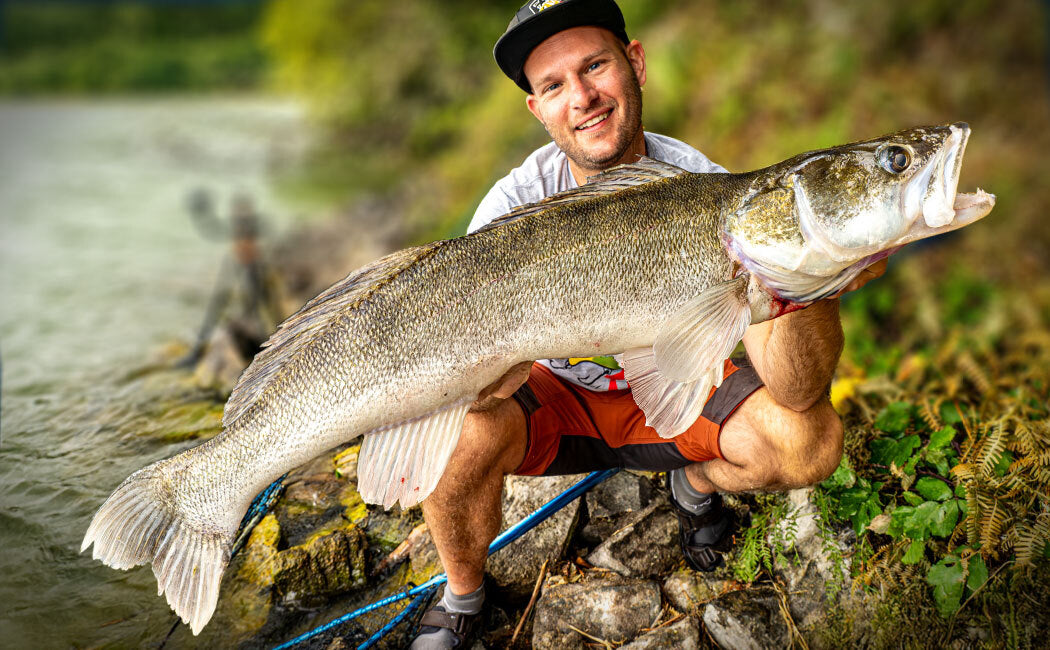
About an hour before the end of the competition, I made a change that turned out to be a real turning point: I switched to a slightly weighted Drunkbait Bourbon Bernd. And what a difference it made. First cast, full distance — a solid tap on the Rodfather. After a brief but intense fight, a decent 44 cm zander slipped into the net. Yes, finally! That scoring fish moved me up several places on a very tight leaderboard.

Pure relief — but nothing more followed, and so I made my way back to the meeting point, drained and exhausted, but satisfied.
Verdict on #WSF2019
In the end, that zander earned me 23rd place — a finish inside the top 10 per cent in the world. Remarkable. Even though the perch lost on day one would probably have meant 15th, I am genuinely proud of the result and feel I represented Team #lmab well.
A big congratulations to the top 10 as well. The conditions were genuinely tough, and every angler who caught fish deserves real credit.
The WSF19 was a great event — good people, noticeably better organisation and plenty of fun. Metz is a stunning and worthy backdrop, packed with fish and interesting spots.
A big thank you again to the lads from Bock auf Barsch, who will also be releasing some footage from the event.
Drunkbait, KØFI and The Rodfather were brilliant companions on this trip — and I can already say now: this event will see me back next year.